By Mark Bodger, Director at ICit Business Intelligence
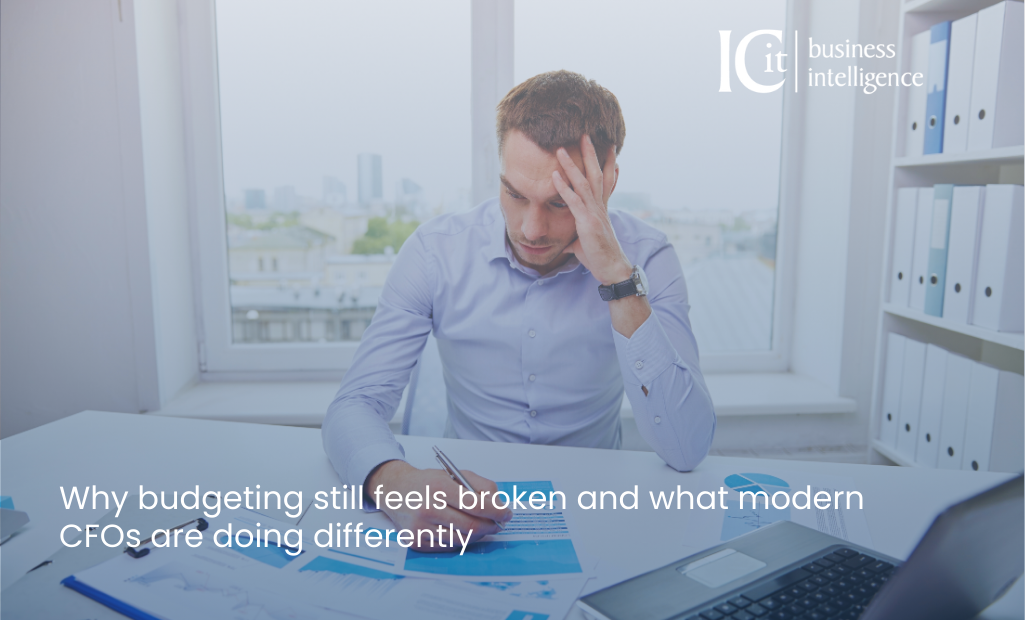
After more than two decades working alongside finance teams, I’ve yet to meet a CFO who actually enjoys the budgeting process. What I have met are capable, intelligent finance leaders who feel frustrated that budgeting still consumes too much time and delivers insight far too late to influence decisions.
In the early days of business, most budgeting processes were designed for a slower, more predictable world. The business has moved on, yet the way we budget hasn’t.
The problem isn’t discipline
Many organisations still treat the budget as an annual event: a long, exhausting cycle that culminates in a fixed set of numbers everyone knows will be outdated within months. As conditions change, finance is left explaining variances against assumptions that no longer reflect reality. This isn’t always a failure of control or rigour but more a failure of design.
Modern finance teams need to move away from static, point-in-time budgets and towards rolling forecasts that evolve as the business does. Updating forecasts monthly or quarterly keeps planning grounded and credible. It also shifts the conversation from “Why are we off budget?” to “What should we do next?”
Insight comes from drivers, not debates
Another common flaw is that too many forecasts are built on opinion rather than economics. Long meetings are spent negotiating numbers instead of understanding what actually drives performance.
The most effective planning models focus on drivers: headcount, utilisation, price and volume, churn, pipeline, cost structures and operational capacity. When those drivers change, the forecast updates automatically. Finance stops rebuilding models and starts interpreting outcomes.
This is also where scenario planning becomes genuinely useful. Instead of being a last-minute fire drill, scenarios become a normal habit and quick switches that allow leaders to see the impact of growth or cost pressure before decisions are locked in.
One version of the truth changes everything
If finance teams spend their time reconciling spreadsheets, the organisation will never trust the numbers. Multiple versions and endless “final” files undermine confidence.
A single version of the truth, with consistent structures and definitions, changes the entire tone of conversations immediately. When everyone is working from the same data, discussions can move forward quick and Finance becomes a partner rather than an arbitrator.
This is where modern planning platforms like Workday Adaptive Planning fundamentally change the process. Centralised inputs, driver-based models, controlled access and full audit trails allow budgeting and forecasting to run like a system rather than a collection of fragile files.
Give Finance time to do what it’s good at
Finance teams don’t need fixing but the tools around them do. We too often see highly capable FP&A professionals spending disproportionate time copying, pasting, reconciling and subsequently, explaining delays. Furthermore, it’s work that adds little value and drains motivation. When manual effort is removed, something powerful happens: finance gets its real job back.
Looking to improve your budgeting processes?
At ICit Business Intelligence, we consistently see organisations reduce budgeting and forecasting effort by 50% or more when they modernise their planning approach. That time is then reinvested into analysis, challenge and better decision-making.
Over the next three to five years, the most successful CFOs will not be the best spreadsheet modellers. They will be the clearest thinkers. The fastest decision-makers. And the leaders who equip their teams with systems that turn effort into insight.
If budgeting still feels slow, painful or political, that’s the signal. The answer isn’t more effort. It’s a better way of planning.
As a platinum Workday Adaptive Planning partner, we’ve supported hundreds of organisations on their journey to smarter, more strategic FP&A. If you’re ready to elevate your FP&A function get in touch
In person events and live webinars
We hold a range of in person events and live webinars, where we share our planning & budgeting insights and demonstrate our partners’ solutions. Take a look at the schedule, see what’s coming up and register to attend an event. See Events